
Rare cancer patients warn delays still risk lives despite cancer plan pledges.
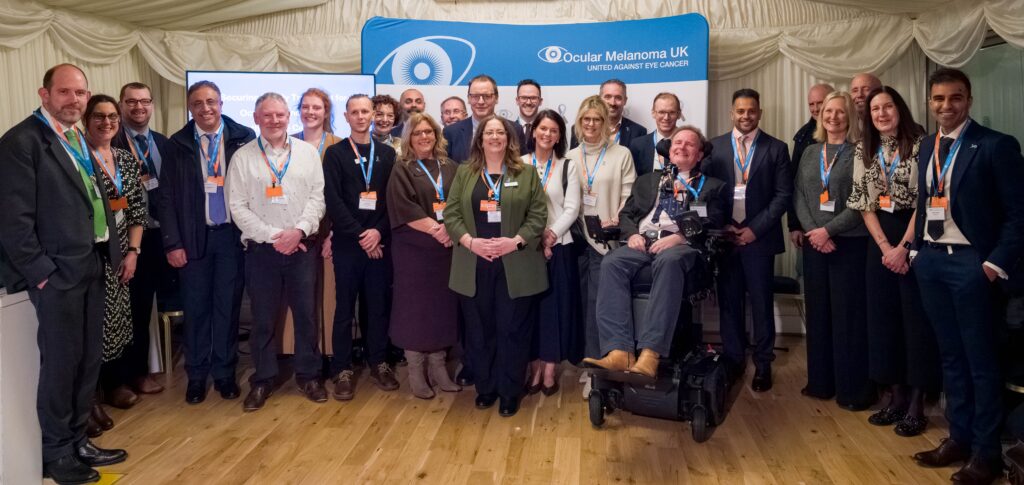
Ocular Melanoma UK Team and attendees at their recent parliamentary reception about securing timely access to treatment for rare cancers.
Patients with ocular melanoma, a rare form of eye cancer, are still being denied a life-extending treatment already delivered in NHS hospitals despite the Government’s National Cancer Plan pledges unveiled today (Wednesday, 4 February), a leading charity has warned.
As ministers set out new commitments aimed at improving cancer outcomes and speeding up access to innovation, Ocular Melanoma UK (OMUK) said the ambition must translate into practical solutions for patients with rare cancers who remain unable to access treatments already available within the NHS.
The charity has supported families of patients who died while waiting for access to treatment, while others have fundraised or paid privately but could only afford a single cycle of therapy despite clinical advice that more would be needed.
The warning follows a recent House of Lords debate on the Rare Cancers Bill, during which Baroness Finlay highlighted ocular melanoma as an example of how current systems can fail patients with less common cancers.
She told peers that once the disease spreads to the liver, standard NHS treatments have very poor outcomes and called for time-limited interim access pathways where clinical evidence and specialist expertise already exist, warning that “time is not on the patient’s side”.
OMUK says this is the situation facing patients needing chemosaturation – also known as percutaneous hepatic perfusion – a treatment delivered at specialist NHS centres but not routinely commissioned.
The procedure delivers high-dose chemotherapy directly to the liver while filtering the blood to reduce side effects. It is available at centres including University Hospital Southampton and The Christie in Manchester.
Clinical studies show chemosaturation can control liver tumours in almost 90 per cent of eligible patients, with a median survival of around 20 months – and some patients significantly longer, as reported in the Annals of Cancer Surgery.
Unlike standard chemotherapy, the treatment isolates the liver from the rest of the body, allowing higher doses to be delivered safely.
Despite being supported by NICE guidance for people with this cancer more than four years ago, the treatment is not routinely available on the NHS.
UK patients can only access chemosaturation by self-funding at a cost of around £40,000 per cycle, while patients from other countries can receive the treatment in the UK funded by their own public health systems.
Jo Gumbs, chief executive of OMUK, said: “The Cancer Plan’s commitment to reducing delays in the implementation of new innovations and technologies across the NHS is welcome – faster access to effective treatments is exactly what cancer patients need.
“However, for people already living with ocular melanoma, this does not solve the immediate problem. Patients remain unable to access chemosaturation while commissioning processes continue.
“Long-term ambition must be matched with interim solutions so people are not left without options while decisions are still being made.
“For people with metastatic ocular melanoma, time is critical. When access to effective treatment is delayed, that lost time has real consequences.”
Ocular melanoma is the most common eye cancer in adults, with around 600 people diagnosed in the UK each year. Up to half go on to develop secondary disease in the liver, where prognosis is poor without timely treatment.
OMUK is calling for interim, time-limited access pathways so patients with aggressive rare cancers are not left without options while longer-term commissioning decisions continue.
Ends
Notes to editors
About Ocular Melanoma UK (OMUK)
OMUK is a registered charity supporting those affected by ocular melanoma. It aims to help patients and their families by providing accurate, up-to-date information and emotional support via its website www.omuk.org, helpline and online forums.
Its vision is a world where ocular melanoma patients are given the information, support and treatment they need.
OMUK’s charitable objectives:
- To primarily promote and protect the physical and mental health of sufferers of ocular melanoma and their families in the UK through the provision of support, information, education and practical advice.
- To support research into ocular melanoma and to publish results.
Ends